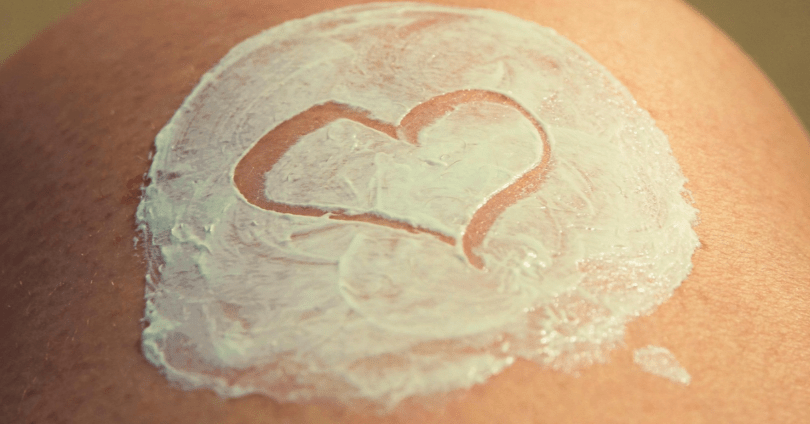
Did you know that you should apply suncream every day, regardless of whether you’re going outside or staying indoors?
That’s because when you’re indoors, the UV rays from the sun can penetrate through glass windows and still damage your skin. Even when it’s cloudy and overcast, it’s still important to protect your skin from sun damage, as clouds block less than 25% of the UV rays!
Implications of sun damage
Sun light is a good source of Vitamin D and is great for our general well-being but if skin is left unprotected and overexposed, then this will lead to the sun damaging the skin’s cellular DNA and can result in:
- Sunburn: As most of us know, too much sun equates to sunburn. This causes inflammation of the epidermis layer, making the skin turn pink or red, causing it to be tender to the touch and the skin to blister and peel. Sunstroke, dehydration, dizziness, and even infection can occur in more severe cases.
- Pigmentation: Over-exposure to the sun causes skin cells to become damaged, which prevents the production of melanin. This then results in parts of the skin turning either lighter (known as hypopigmentation) or darker (known as hyperpigmentation).
- Loss of Collagen: Sun exposure breaks down the skin’s collagen, causing wrinkles and sagging. It also leaves skin thinner, which makes conditions such as thread veins look worse.
- Actinic Keratoses (AKs): These AKs are a type of pre-cancer and require immediate medical attention. They appear as small crusty bumps on the skin and can vary from the size of a tiny blemish to an inch in diameter.
- Skin Cancer: Over-exposure or long-term exposure to the sun can lead to skin cancer. So, if you notice new moles or existing moles that have changed shape, colour, size, height, or have become irritated or start bleeding, then it’s important to seek immediate medical attention.
Mineral vs. chemical suncream
When looking at how to protect your skin from sun damage, your best bet is a suncream, and did you know that there are two main types of suncreams?
- Mineral-Based: Forms a physical barrier to help reflect UVA and UVB rays. These creams are gentler on the skin, making them ideal for those with sensitive, dry, and eczema prone skin.
- Chemical-Based: Absorbs rays and converts them into non-damaging heat via a chemical reaction. These creams tend to be more lightweight, easier to rub into the skin, and wont leave a white cast on the skin.
Choosing the right level of SPF
Sun Protection Factor (SPF) is a measure of how effectively a suncream can shield your skin from the sun’s ultraviolet (UV) radiation, but do you know which factor is best for you and your skin?
- SPF 15 is ideal for those who are going to spend a limited amount of time outside, such as commuting to work or running errands as it only blocks approx. 93% of UVB rays.
- SPF 30 is recommended for those who spend a significant amount of time outdoors during peak sun hours (10 AM to 4 PM) as it blocks approx. 97% of UVB rays, offering moderate protection.
- SPF 50+ blocks out about 98% of UVB rays, making it ideal for those with fair or sensitive skin that burns easily and those who spend a prolonged period of time outside.
Sources
Allure Beauty Concepts. Understanding SPF Levels. Published 26 October 2023. https://www.allurebeautyconcepts.com/news/understanding-spf-levels
CeraVe. Mineral vs. Chemical Sunscreen: What’s the Difference? Last accessed 01 March 2025. https://www.cerave.com/skin-smarts/skin-concerns/sun-protection/mineral-vs-chemical-sunscreen
Sk:n. Sun damage Causes, symptoms and treatment..Last accessed 01 March 2025. https://www.sknclinics.co.uk/conditions/sun-damage
CeraVe. What is Sunscreen? Last accessed 01 March 2025. https://www.cerave.com/skin-smarts/skin-concerns/sun-protection/what-is-sunscreen
Skin Cancer Foundation. All About Sunscreen. Last accessed 01 March 2025. https://www.skincancer.org/skin-cancer-prevention/sun-protection/sunscreen/
Paula’s Choice. What is SPF & how does it work? Last accessed 01 March 2025. https://www.paulaschoice.co.uk/how-spf-works
La Roche-Posay. Why you should wear sunscreen all year round. Last accessed 28 February 2025. https://www.laroche-posay.co.uk/en_GB/why-you-should-wear-sunscreen-all-year-round-dermatologist-dr-hiva-fassihi-explains.html
 Reviewed by Hanna